
Dustbound
At-a-Glance
I developed the video game Dustbound from start to finish. Dustbound was commercially released on the PC platform Steam and combines survival action with card-based strategy. I led the full design process, from early concept development and design documentation to rapid prototyping, system design, and playtesting. Throughout development, I designed and iterated on complex gameplay systems, user interfaces, and progression mechanics, informed by ongoing user research and feedback, to ensure clarity, balance, and a cohesive player experience.
Timeline
1 Year
My Role
Lead UX, UI, Product and Game Designer
Collaboration
2 Freelancers
Platform
Figma,
Unity
Problem
Because gameplay is highly fast-paced, players had little to no time to read UI elements or process detailed information. Early playtests revealed that this led to cognitive overload, with players missing critical information and feeling overwhelmed by the strategic depth during moment-to-moment gameplay.
Solution
I redesigned systems and UI to prioritize instant readability and decision-making under pressure. Information was simplified, visual cues replaced text where possible, and interactions were streamlined so players could understand choices at a glance without interrupting gameplay flow.
Research
I conducted user tests and gathered qualitative feedback focused on onboarding clarity, system comprehension, and player drop-off points. By observing play behavior and identifying friction moments, I analyzed where players struggled, rushed decisions, or disengaged from core systems.
Key Insights
-
Players consistently skipped long explanations and text-heavy tutorials
-
Walls of text were ineffective in fast-paced gameplay contexts
-
Clear visual feedback and immediate cues were critical for understanding systems
-
Players learned systems more effectively through interaction than instruction


System Design
I designed multiple complex and engaging systems and structured them to feel simple and approachable at the beginning, gradually unfolding deeper layers of complexity as players progress and master the game.
Deckbuilding Through Exploration
Like in classic deckbuilders, the player can expand their build by collecting new cards and augments. However, instead of receiving these passively through menus or post-battle rewards, players must actively explore the map, fight their way through enemies, and reach chests to obtain them.
The Design Challenge
Early in development, opening too many chests led to rapid accumulation of augments, causing power creep and disrupting balance.
The Solution
To regain control over progression:
-
Players can only add an augment every second chest they open.
-
Once they have five augments, they can only add one every third chest.
-
This keeps build growth meaningful and paced, while preserving player agency and exploration.


Efficient Card Upgrade System
I implemented an upgrade system designed to work well for a solo developer with limited resources. In this system, each individual card has four possible upgrades that can be unlocked by combining two cards of the same level.


Weapon System
By playing cards, the player can upgrade core stats, add new drones, or enhance existing ones.
Drones follow the player and provide active defense by firing projectiles at enemies. Each drone module comes with a distinct weapon type and a unique visual design.
This system fits naturally into the game's lost-world atmosphere. Instead of spawning weapons out of thin air, drones give the player a tangible source of firepower, which helps ground the experience and deepen immersion.
Paper First
The process below begins with my initial ideas and wireframes, then moves to mockups and finally to the high-fidelity prototype. In this simplified overview, you can see how user needs shaped the design decisions throughout the process.

Low-Fidelity Prototypes
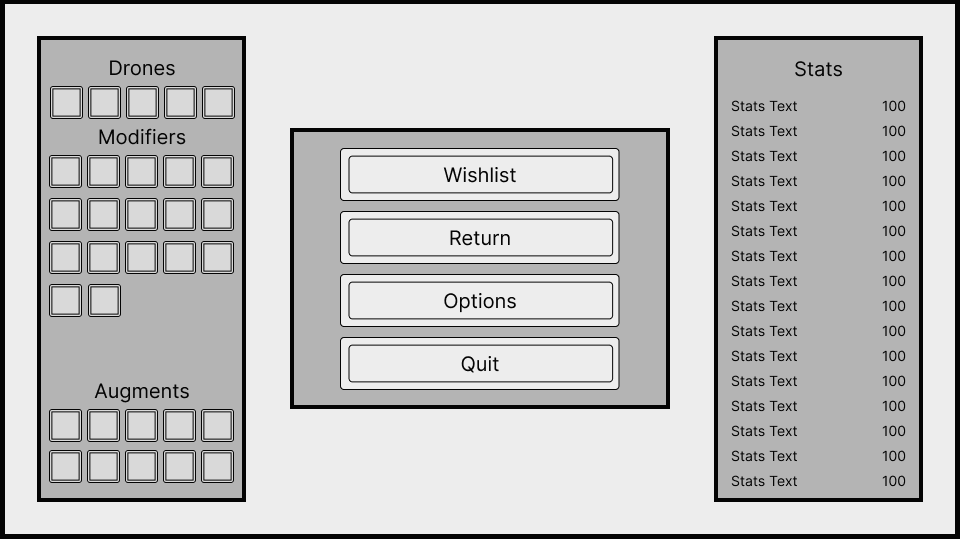
I then created a digital low-fidelity prototype in Figma to effectively communicate my design ideas with freelancers.



High-Fidelity Prototypes


